

1. The GLP-1 Catalyst: Where DTP Wins Today
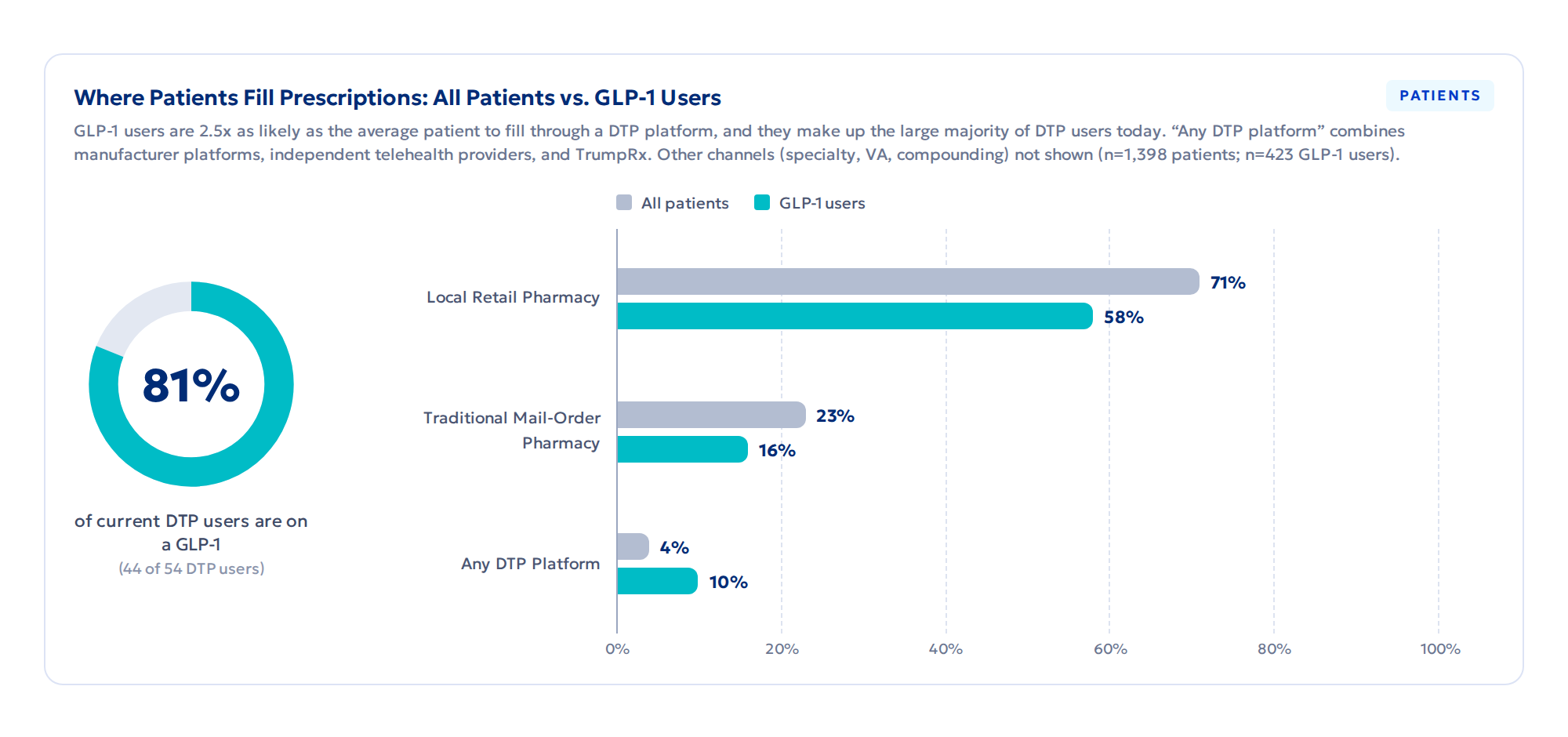
While DTP platforms are being deployed across multiple therapeutic areas, actual fill adoption remains heavily concentrated. Overall, only 4% of all surveyed chronic patients currently use a DTP platform for prescription fills. However, when we zoom in on therapeutic categories, a clear engine emerges: 81% of current DTP users are on a GLP-1, and 10% of GLP-1 users fill through a DTP platform, compared to 4% of all patients.
Every other major specialty, including autoimmune, cardiometabolic, respiratory, and mental health, sits at 4% or less of total script fills through DTP channels.
The Cash-Pay Dynamic: Cost Bypasses Coverage
Why are GLP-1 patients leading the charge? Because DTP has become a vital access workaround when payer coverage falls short.
- 77% of GLP-1 DTP users bypassed insurance entirely to pay a flat cash price at checkout.
- 82% of GLP-1 DTP users pay over $100/month out-of-pocket (compared to just 28% of non-DTP GLP-1 users).
- 80% of current DTP GLP-1 users remain highly likely to continue using their platform, proving that upfront price transparency and guaranteed access create strong brand loyalty even at higher out-of-pocket price points.
2. The Adoption Bottleneck: Awareness vs. Comprehension
For pharma marketers, the survey reveals a critical funnel drop-off: Reach is not the constraint; comprehension is.
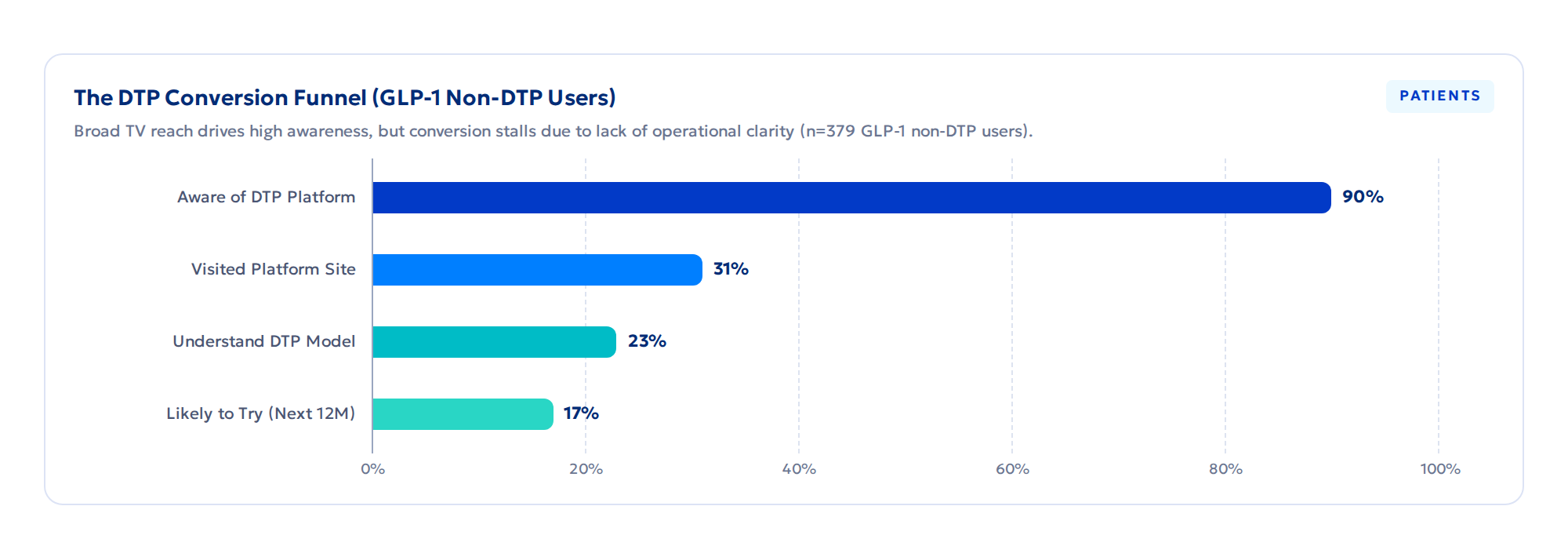
While 95% of patients are aware of at least one DTP platform and 40% have visited a platform website, only 4% have converted to a prescription fill. Even among GLP-1 patients not currently using DTP, 90% have heard of a platform, but only 23% understand how the model actually works.
Why Do Patients Stall Before Filling?
When asked why they haven’t used DTP platforms, non-users cite relational and routine barriers:
- 47%, Relational Tether: Want their own local, face-to-face physician to remain the sole manager of their scripts.
- 35%, Routine Inertia: Comfortable with their current retail routine and reluctant to learn a new digital system.
- 29%, Trust & Safety: Unclear if DTP platforms provide the same pharmacist oversight as local brick-and-mortar retail.
3. The Physician Role: Essential Catalyst & Gatekeeper
A major misconception in direct-to-patient marketing is that DTP bypasses the traditional healthcare provider. The data tells the exact opposite story: Physicians are the primary catalyst for DTP adoption.
Among current GLP-1 DTP users, 70% had their own doctor send the prescription to the platform, and 57% chose their platform based on a doctor’s recommendation. Furthermore, 49% of non-users say they would try DTP if their doctor suggested it.
The Broken Feedback Loop
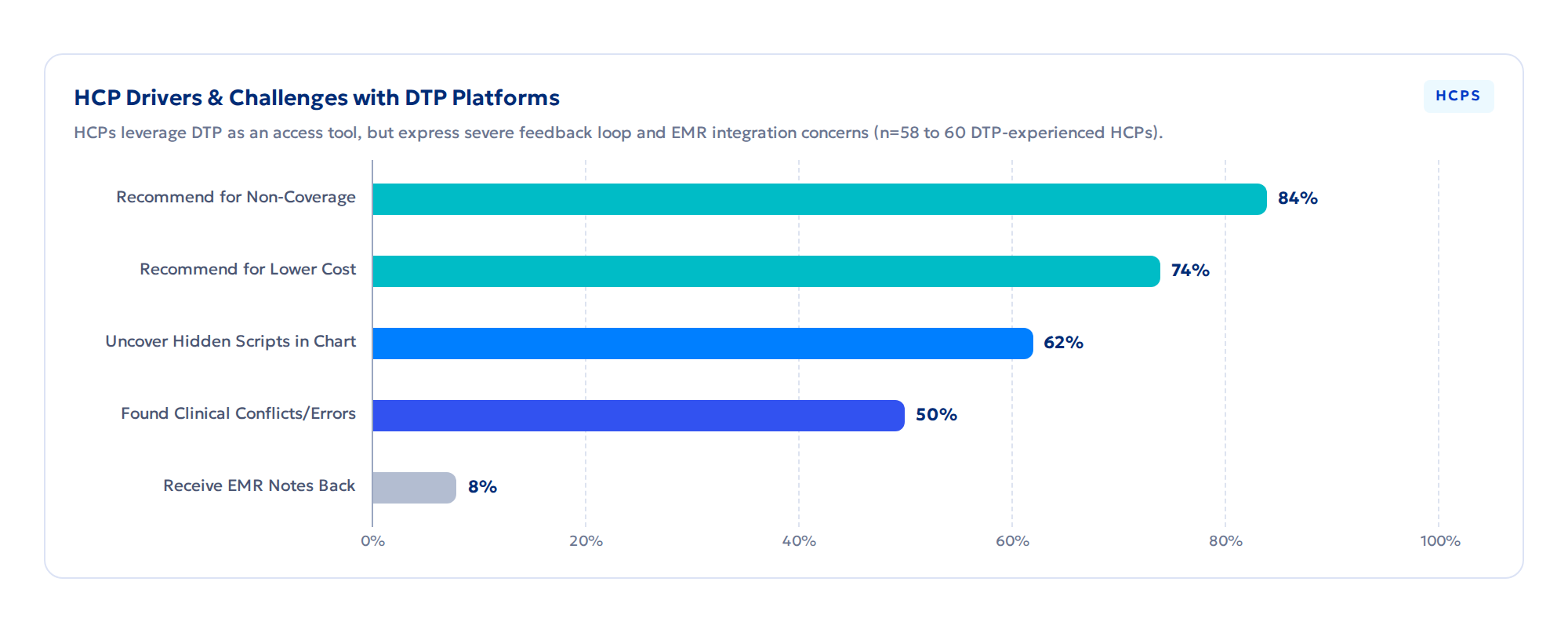
While HCPs rate DTP higher than retail pharmacy on cost and price transparency, clinical friction is rising:
- Only 8% of HCPs frequently receive clinical notes or EHR updates back from DTP telehealth providers (45% never or rarely do).
- 62% of HCPs have discovered an active DTP prescription in a patient’s chart without prior knowledge.
- 50% of HCPs have uncovered clinical conflicts (e.g., incorrect dosage, therapeutic contradictions) originating from DTP scripts requiring intervention.
- Continuity of care concern gap: 26% of Primary Care Physicians / NPs / PAs worry DTP harms continuity of care, compared to just 7% of Endocrinologists.
4. Actionable Strategies for Pharma Marketers
To bridge the gap between initial website visits and actual prescription fills as DTP models scale up, brand leaders must reallocate budget and refine messaging:
1. Shift Spend from Broad Awareness to Functional Comprehension
TV campaigns generate massive baseline reach (72% learned of DTP via TV), but don’t explain how the fill process works. Marketers must invest in educational content detailing step-by-step pharmacy routing, insurance handling, and out-of-pocket comparisons.
2. Target the Prescriber as a Primary Channel
Treat DTP as a fulfillment tool for local HCPs rather than purely a DTC telehealth play. Provide rep enablement materials that explain how HCPs can seamlessly route e-prescriptions to manufacturer platforms when prior authorizations fail.
3. Reassure Primary Care on Continuity of Care
Position DTP as a fulfillment partner that keeps the primary physician in control. Prioritize EMR integration and automated closed-loop clinical note write-backs to eliminate “surprise” scripts and reassure anxious PCPs.
4. Focus Infrastructure on High-Value Features
Patients view DTP as a pharmacy partner, not a lifestyle app. Focus development on core transactional utility: automated refill alerts (used by 52%) and condition/side-effect education (used by 41%), while deprioritizing AI intake or generic coaching tools (used by only 7%).
5. What This Means for Health Communities & Advertisers
As DTP platforms ramp up and patient awareness matures, the digital healthcare ecosystem, especially trusted health platforms and patient communities, plays a pivotal role in preparing and supporting patients.
Impact on Health Communities
- Peer Validation Hubs: Patients turn to online communities to demystify complex access routes. Peer discussions around “how I got my prescription filled” will become critical conversion touchpoints.
- Navigating the Experience: Communities must provide unbiased educational guides explaining the mechanics of manufacturer DTP vs. traditional retail vs. mail-order pharmacy.
- Emotional Support in Access: As patients deal with cash-pay decisions and insurance denials, community moderation and support resources will help reduce treatment fatigue.
Opportunities for Advertisers
- Contextual Media Alignment: Advertisers should place DTP educational messaging directly adjacent to condition-specific treatment discussions, where intent is highest.
- Doctor-Patient Conversation Starter Ads: Media creative should focus on equipping patients with discussion guides (e.g., “Ask your doctor if sending your script via [Platform] is right for you”) to bridge the HCP recommendation gap.
- Beyond DTC Ads to Point-of-Care Support: Digital advertisers can capture high-intent audiences by sponsoring pricing transparency tools, coverage checkers, and fulfillment calculators within trusted health environments.
Conclusion
Direct-to-Patient platforms are not replacing traditional healthcare relationships. They are complementing them as vital access workarounds. For pharma marketers, scaling DTP requires shifting focus from top-of-funnel TV reach to mid-funnel comprehension, reassuring primary care doctors, and leveraging trusted health communities to guide patients smoothly from awareness to fill.
Source: Health Union 2026 DTP Patient & HCP Research Report.
Want the full DTP survey findings?
Our Insights team can walk your brand or agency through the data for your therapeutic area and what it means for your 2027 plans.