
The Opt-Out Reality: Many Chronic and Rare Condition Patients Skip AI Entirely
While AI adoption is climbing fast in the general population, chronic disease communities show a very different dynamic.
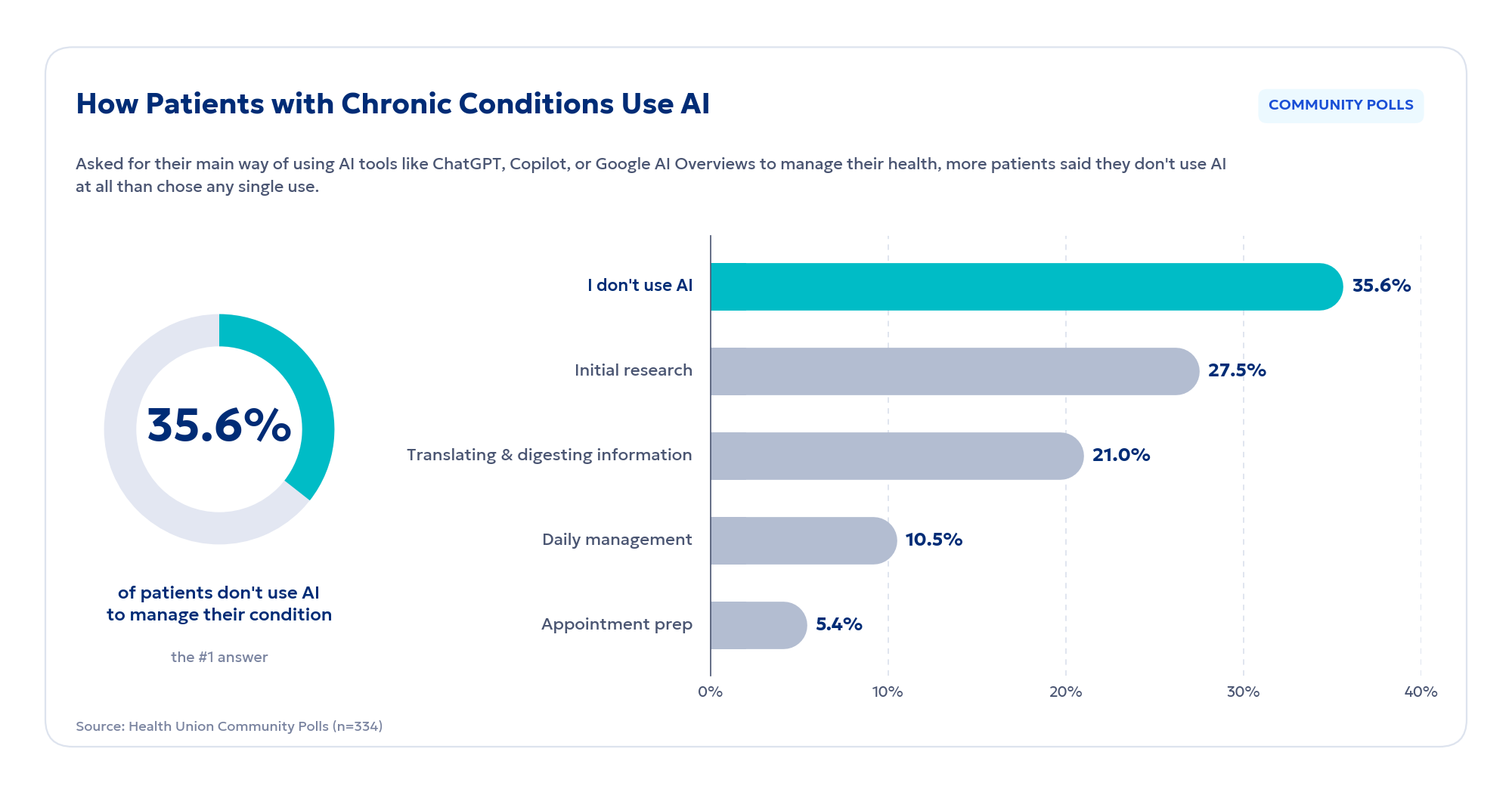
When asked about their main way of using AI tools like ChatGPT, Copilot, or Google AI Overviews to manage their health, the single most popular answer selected by patients was “I don’t use AI” (35.6%). Over a third of patients opt out of using AI entirely for their condition management.
The Education and Awareness Gap
Trust remains a major hurdle. Only 3.2% find AI-generated health answers entirely trustworthy; the rest split almost evenly between quick facts only (34.3%), a starting point to verify (32.1%), and no trust at all (30.4%).
The Boundaries: What Patients Won’t Use AI For
Patients who do use AI draw hard lines around where the technology belongs. When asked what they do NOT use AI for when managing their health, patients protected two areas above all else: making treatment decisions (27.2%) and emotional support and coping (26.6%).
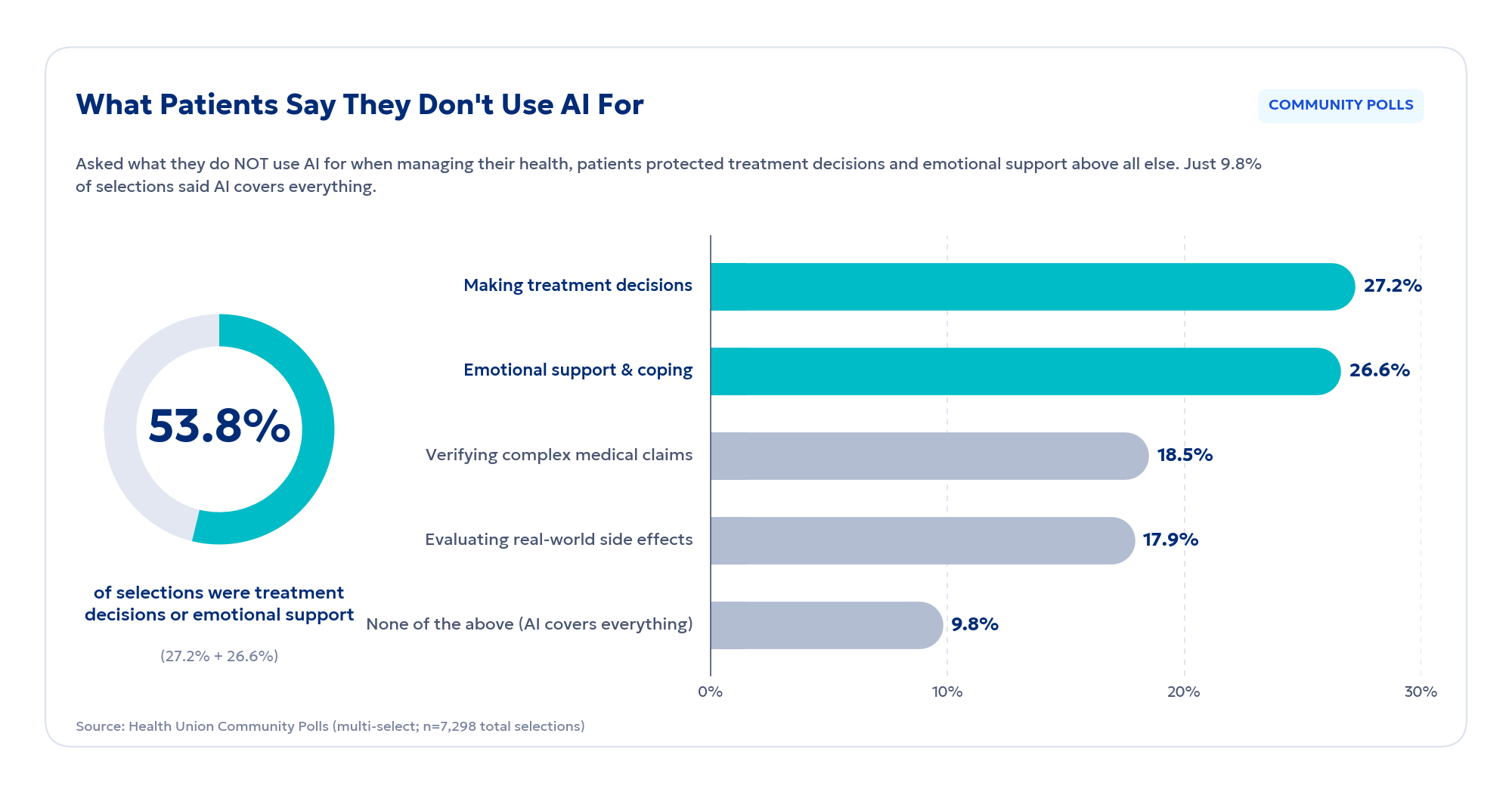
Just 9.8% of selections said AI covers every aspect of the health journey.
When asked what is missing from AI summaries when researching complex conditions, 37.5% point to reliability and 33.8% cite a lack of lived experience. Algorithms can aggregate facts, but they cannot replicate the lived experience of navigating a chronic illness.
What Actually Drives Treatment Discussions?
For healthcare marketers aiming to prompt meaningful discussions between patients and their physicians, relying on AI recommendations is not enough.
When asked what is most likely to convince them to discuss a new treatment option or clinical trial with their doctor:
- 54.7% selected clinical research studies and medical journals.
- 28.3% selected first-hand patient stories.
- 11.1% selected an AI search recommendation.
- 5.9% selected official brand brochures or advertisements.
Rigorous scientific proof and authentic peer experiences carry far more weight in driving health actions than AI summaries.
The Misconception of “Blind Trust”
A persistent myth in healthcare marketing is that patients take AI search results at face value. When asked about the biggest misconception regarding their AI search habits, 43.4% of patients rejected the idea that they “blindly trust” what AI tells them.
Instead, AI acts as a staging ground. After reading an AI summary about a diagnosis or drug:
- 42.6% go straight to their own notes to prepare for their next doctor visit.
- 32.7% cross-reference the information on pharma or clinical trial sites.
- 22.1% turn to patient forums and peer communities to validate the information.
- 2.6% selected another option.
For brands, this shows that trust isn’t earned just by showing up in AI summaries; it’s earned by connecting with people.
“More than just being the brand that patients want, I think it’s also important to be a brand that earns trust and builds relationships that reflect the real lives of the people they’re serving.” – Health Union Patient Leader Council Member
High-Skepticism Segments: The Case of Neurological Communities
Skepticism toward AI is not uniform across all conditions. Data across individual Health Union communities revealed that patients living with complex neurological conditions display notably higher levels of caution:
- MultipleSclerosis.net: 56% of community members say they do not use AI at all for their condition, compared to the 36% overall average.
- Myasthenia-Gravis.com: 65% rely on published research studies to consider a new treatment, compared to 55% overall.
- Migraine.com: 57% identified “blindly trusting AI” as the single biggest misconception about their search habits, compared to 43% overall.
Key Takeaways for Pharma Marketers
To win patient trust in the age of AI, pharma brands must show up in the human spaces behind the search results:
- Balance discovery with action: An AI overview may spark awareness, but patients need clear next steps to get to their doctor.
- Lead with lived experience: Real peer stories are second only to clinical research in prompting a treatment conversation.
- Meet patients in active spaces: Show up in the forums, support groups, and trial communities where patients validate claims.
- Ask, don’t assume: How patients use AI varies by condition and community, so ask your audience directly.
As pharma marketers navigate the shift toward generative engine optimization (GEO) and AI-driven search, winning long-term trust comes down to remembering the human behind the query.
About the data: Results come from eight Health Union community polls fielded across 45 chronic and rare disease communities in August 2026, totaling 7,800+ responses. Polls are unweighted and sample sizes vary by question; percentages may not total 100% due to rounding or “other” responses.