What AI is not changing
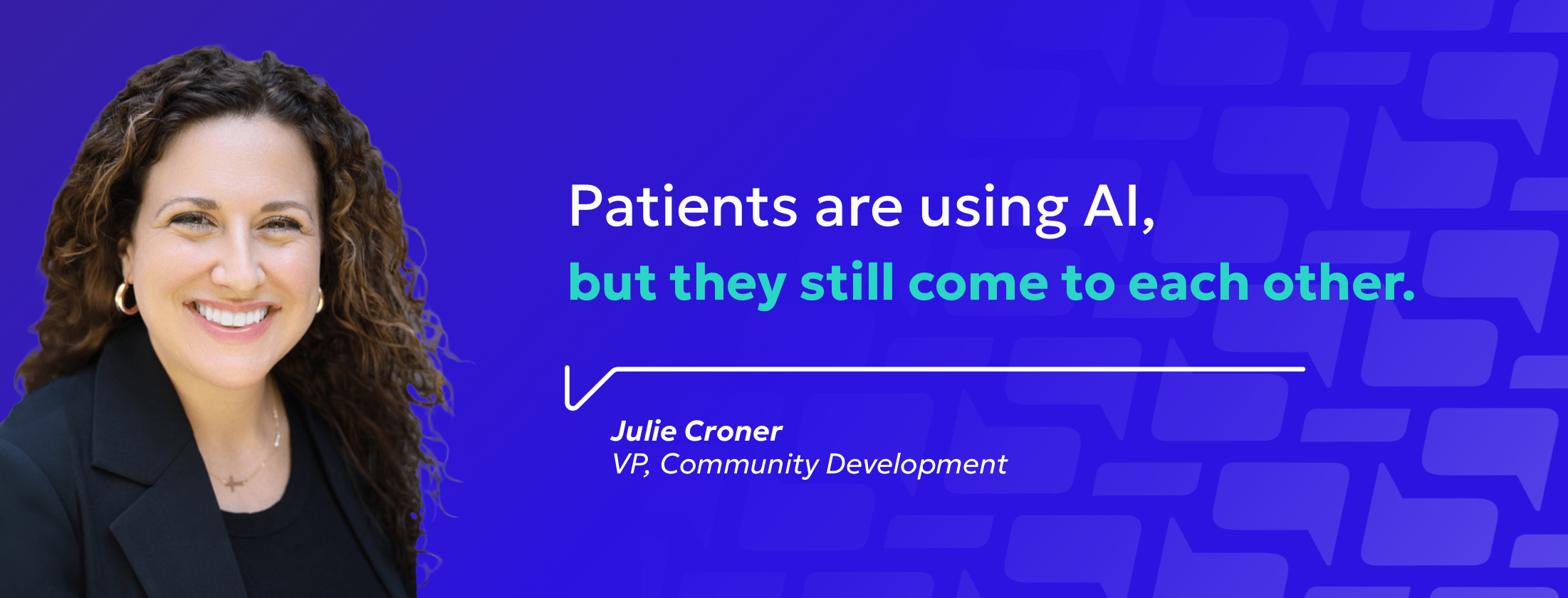
Where people go to feel less alone. That line has held across every conversation we have with our members, without exception. They will let a model organize their information. They will not let it hold their fear.
Anna Williams, who moderates a migraine group and runs a global community of more than 26,000 people, put it plainly: “Nothing will replace talking to another human, the care, reassurance of not being alone, and being able to sit with others.” AI can handle the information. It cannot handle the human. Patients know that difference far better than the marketers trying to reach them do.
The people you assumed AI would replace matter more now
There is a common assumption that AI will thin out the need for human health leaders. In the communities I work in, the opposite is happening. Anna made this exact case on a panel at UConn: patient community moderators are the ones actively fighting misinformation and closing the gap between patients and doctors. “We actually combat misinformation and really are the bridge between patients and clinicians,” she said. “They only have minutes, whereas in the groups we can take time to explain things much better.”
Doctors have seconds. Communities have time. AI did not change that equation, it made the trusted human voice in the middle of it more valuable, because there is now more noise for that voice to cut through.
The skepticism is real, and dismissing it will cost you
Not everyone in these spaces is enthusiastic. Some are alarmed. Dr. Paula Bruno, a member and author, has written about what she calls “AI slop in chronic illness online spaces,” and her warning is sharp: “Real people would ask real questions and real people would give answers. That is all changing, and not for the better. Gaslighting and medical abuse are very real issues in the chronic illness community. How can you defend yourself if you only know AI slop?”
You can debate the intensity of her statement, but you cannot dismiss the point. This is a population that has been burned by institutions that promised help and did not deliver it. A brand that shows up waving AI as the answer and talks past that skepticism will not read as innovative. It will read as one more institution that did not listen. Credibility in patient communities is spent, not assumed.
There is a right way to use AI, and it starts with the patient
None of this means AI has no place in patient spaces. It means the starting point is the patient, not the algorithm.
We tested that idea. We showed our health leaders a tool that uses AI to comb through our own community’s content and surface personalized resource paths based on where someone is in their journey. Not generic model output. The content real patients had already created, made easier to find. The reaction was immediate. Tameka Simmons, a health leader and rare disease caregiver, said, “This could have saved me so much time 10 years ago. In the beginning, when you’re receiving so much information, it’s so overwhelming. To have a tool that is super accessible and easy to use, I can get behind this type of usage for AI.” Natalie Hayden, another health leader, added, “This really taps into the idea of personalizing the patient experience, and that’s what we’re all looking for.”
That is the model worth copying. The AI was not replacing community or human connection. It was making the trust that already existed easier to reach. The line between “AI slop” and a tool patients welcome comes down to one question: is it generating content, or is it helping people find the real thing faster?
Where this leaves pharma
The question I keep hearing from brands is how to use AI to reach patients. But I believe this is the wrong question. The better one is harder and more honest: how do we protect and amplify the human spaces patients actually trust, at a moment when AI is flooding those spaces with generic content and making authentic voices harder to find?
The brands that win the next few years will not be the ones with the most AI. They will be the ones that understood what AI could never touch and invested there. Patients already know what they are looking for. It was never the algorithm, it was each other. Our job is to make sure that when they go looking, the real thing is still there to find.