Many Claim to Have High-Intent Audiences. We Can Prove It.
What 2,448 diagnosed patients told us about engagement, action, and intent – and what that means for your brand.
By Meghan McNally
VP, Integrated Marketing, Health Union
Published June 23, 2026 | 4 Minute Read
Every healthcare marketer is chasing the exact same thing: a high-intent audience. You want the self-advocates, the active decision-makers, and the patients who don’t just passively consume health content, but actually do something about it.
But in healthcare media, there is a massive gulf between a standard “diagnosed patient” and a Health Union community member.
Our online communities act as a natural magnet for highly engaged individuals. True community provides something a basic search engine cannot: validation, trusted peer support, and deep shared experience. This unique environment attracts people who are inherently proactive about their health. They aren’t just waiting around; they are actively optimizing their care.
The result? When you partner with Health Union, your marketing dollars work harder. You are reaching a concentrated, high-intent audience at critical decision-making crossroads. Because they are deeply involved in their own healthcare, they are more likely to see your ads, more likely to recall them, and far more likely to take immediate action and convert.
The comparison most audience claims skip
Plenty of partners will tell you their audience is engaged. We measured it, and we measured it against the toughest possible benchmark. The 2026 Community Value Survey didn’t compare our members to the general public. It compared them to a panel of people carrying the same diagnoses, screened into the same conditions across seven therapeutic areas. Cancer to cancer. Migraine to migraine. Rare disease to rare disease. In total, 2,448 diagnosed patients and caregivers, 1,763 from Health Union communities and 685 from a general-population panel.
So when a Health Union member turns out to be 36% more likely to be an active information-seeker, that lift isn’t “sick people versus healthy people.” It’s two groups who, on paper, should behave identically. They don’t. And both groups rate their overall health the same, so this isn’t about one group simply being sicker. It’s about how they engage.
They’re already in the system
Our members don’t wait. They’re in front of doctors more often and they come prepared:
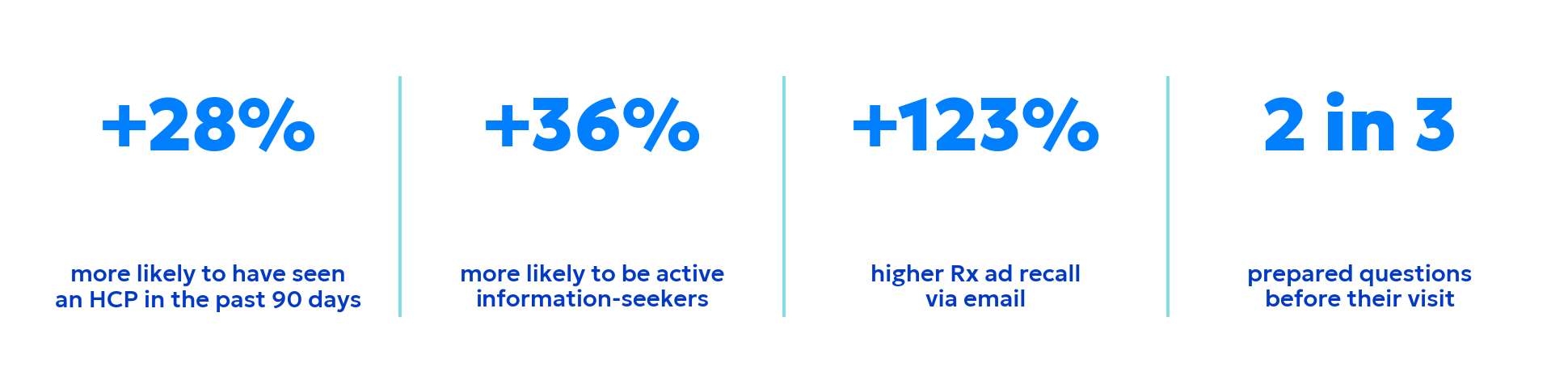
- 88% saw a healthcare provider in the past 3 months vs. 69% of other diagnosed patients (+28%).
- 86% see a primary care provider every year (+16%), and they see specialists at far higher rates across every therapeutic area.
- 2 in 3 (66%) prepared questions before a visit in the past six months, vs. 50% (+32%).
- 34% took notes or recordings during an appointment vs. 26% (+32%).
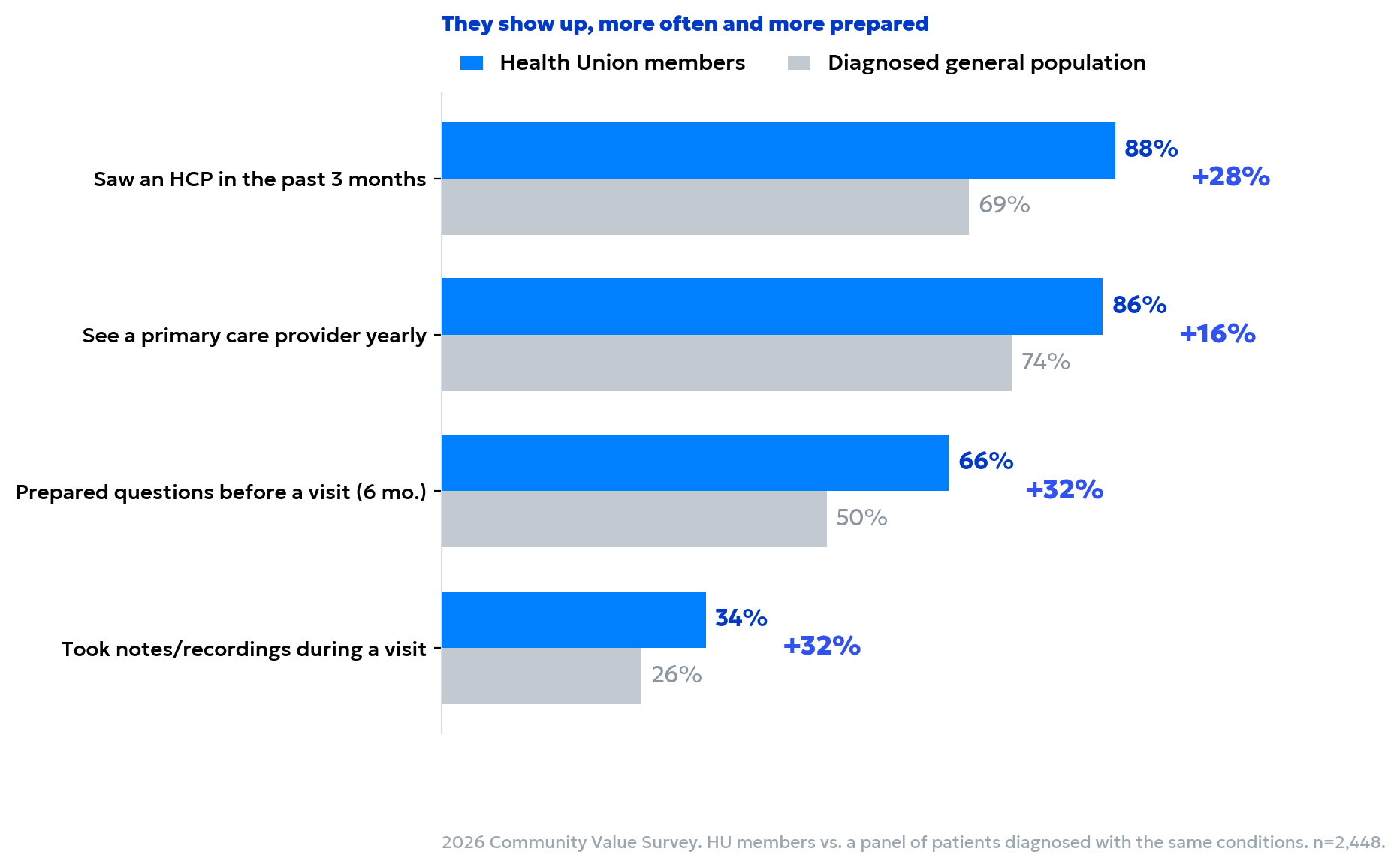
So what for your brand: You’re reaching high-intent audiences during active treatment windows, when the appointment that decides a prescription is days away, not someday.
They take the lead on their own care
This is an audience that researches, advocates, and acts as a partner in the exam room rather than a passive recipient of instructions:
- 74% are active information-seekers about their health, vs. 55% (+36%).
- 73% call themselves strong advocates for their own care, vs. 60% (+22%).
- 69% are involved in their health decisions rather than just following the doctor’s lead, vs. 57% (+21%).
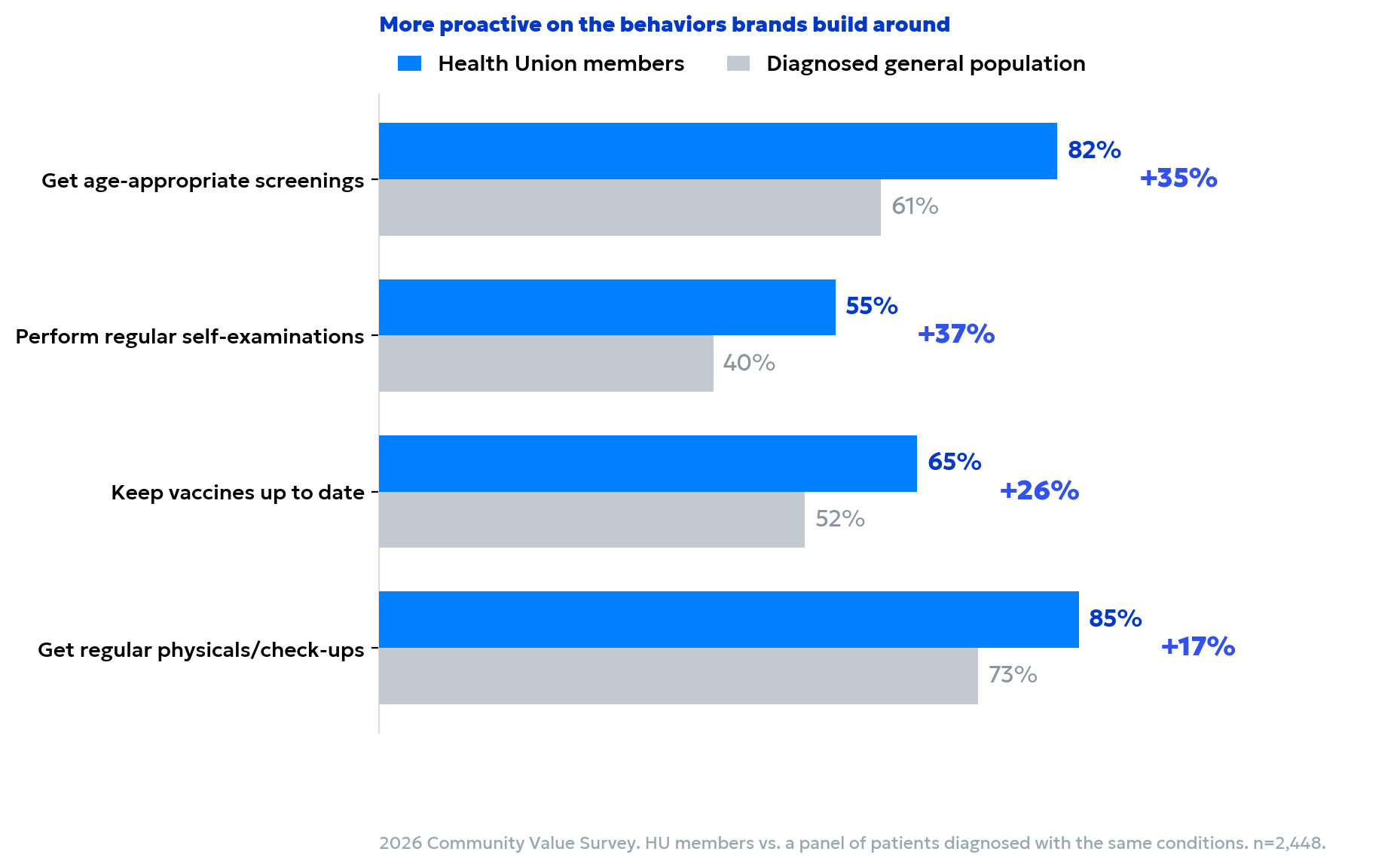
- They’re also more proactive on prevention: 35% more likely to get age-appropriate screenings (82% vs. 61%) and 26% more likely to stay current on vaccines (65% vs. 52%).
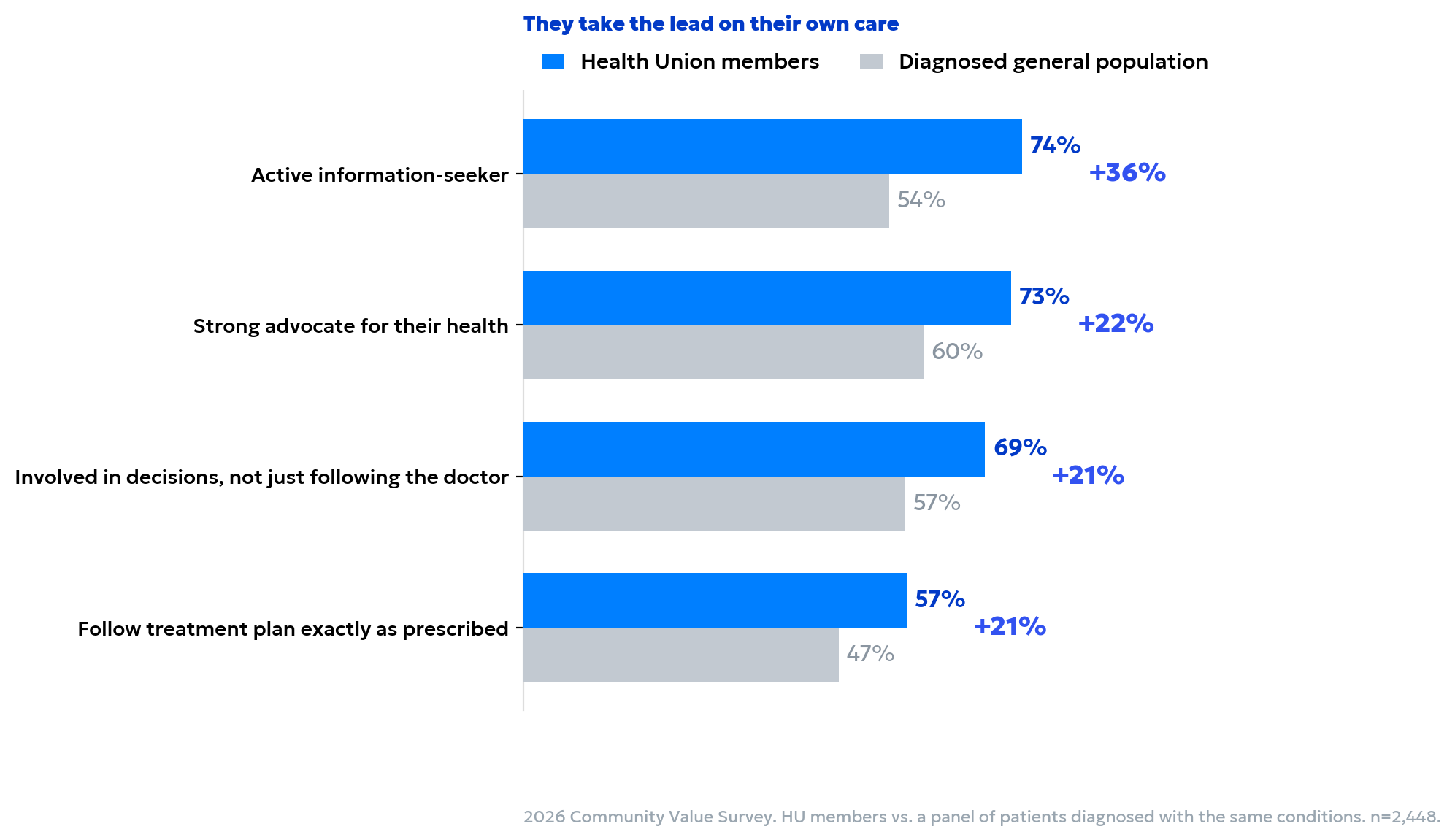
So what for your brand: These are the people who look things up, bring your brand name into a conversation with their doctor, and follow through. Your message gets carried forward, not forgotten.
They see your advertising. And they act on it.
This is where audience quality turns into media performance. Health Union members have higher recall of Rx advertising on every single channel measured, and the gaps are largest in the channels brands fight hardest to be remembered in:
- Email: 123% higher recall (38% vs. 17%).
- Print: 114% higher recall (43% vs. 20%).
- Online / banner: 66% higher recall (61% vs. 37%).
- Social media: 43% higher recall (64% vs. 45%).
- TV: 17% higher recall (84% vs. 72%).
Recall only matters if it produces movement. It does. After seeing an Rx ad, Health Union members are 54% more likely to visit a condition-specific site for more information (26% vs. 17%), and more likely to visit the medication’s own website and run their own search.
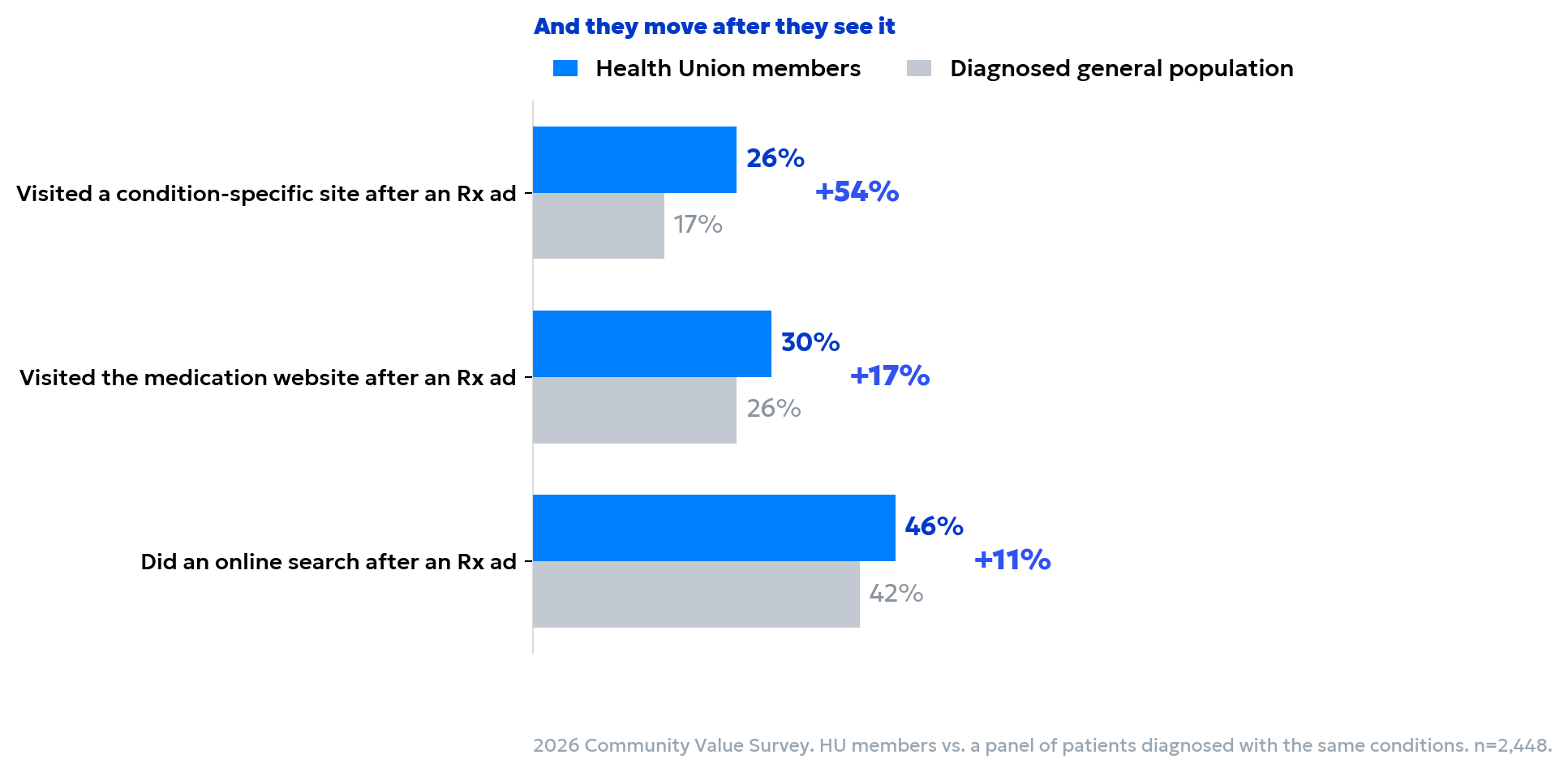
So what for your brand: Same flight, same budget, more impressions that actually register, and more of those impressions converting into the next step toward your brand.
The community is the engine
None of this is an accident. People come to Health Union communities for trusted, peer-validated information and leave having taken an action. Among our members:
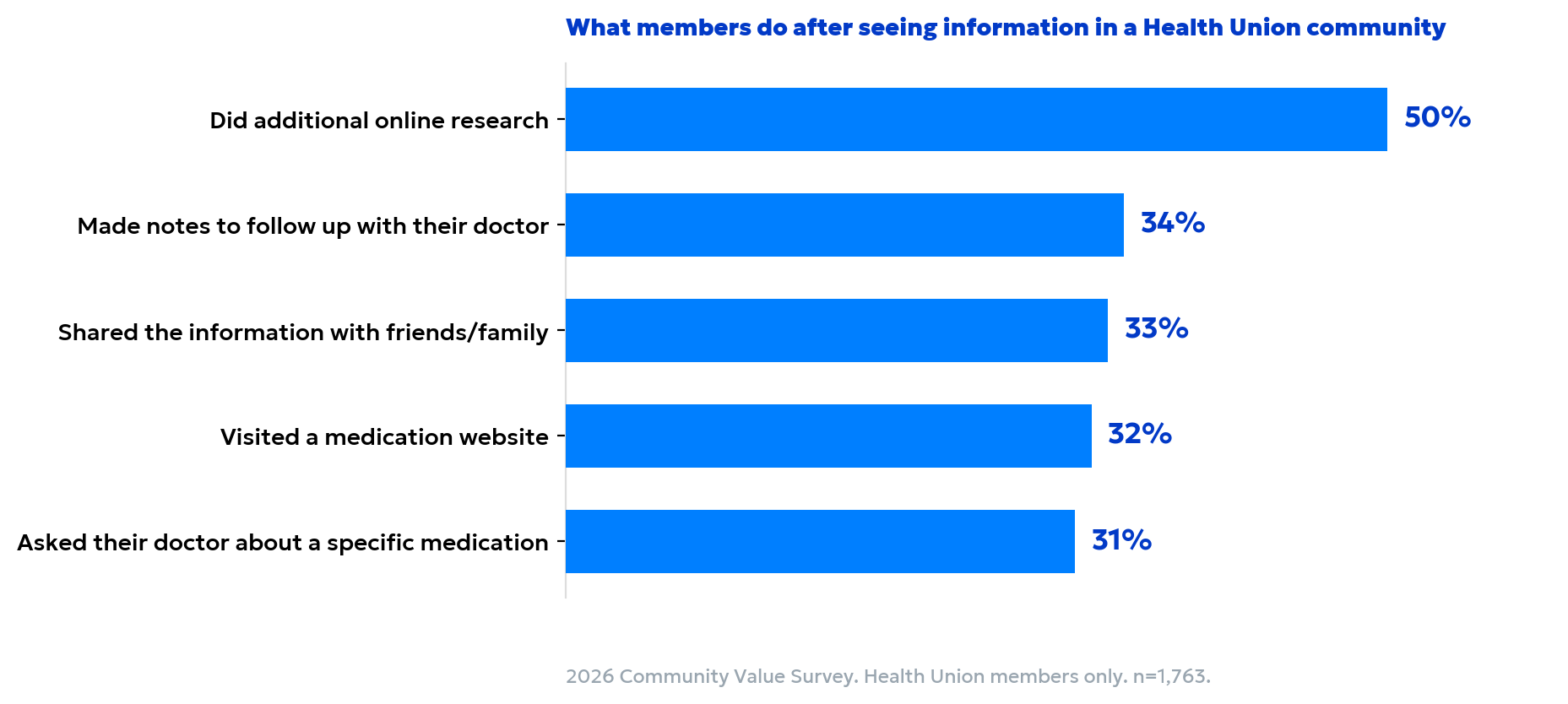
- 50% did additional online research based on information they saw in a Health Union community.
- 34% made notes to follow up with their doctor.
- 32% visited a medication website and 31% asked their doctor about a specific medication.
- 35% strongly agree the community provides trusted, credible content, the foundation that makes the rest happen.
Why it matters for your brand: Trust that translates to outcomes.
You’re buying attention from people at the exact moments that decide outcomes: before the appointment, during the research, at the point where a question becomes a conversation with a doctor. That is the high-intent audience every brand is trying to find. With Health Union, you’re not hoping to reach it. You’re reaching it by definition.
So the next time you weigh a media partner on reach and price, ask the question those numbers can’t answer: once the ad is served, who actually does something about it? For our communities, the answer is most of them.